Not "fixable with the right technique." Not "almost there if you just push through it."
Never broken. Not once. Not even then.
To anyone who has ever sat in a parked car outside a party they drove to, and left without going in — I want to tell you something. But first, I want to describe a moment.
You walk into the café.
The door closes behind you and your chest tightens, just slightly, the way it always does. You glance at the counter and look away too quickly. There's a queue. You join it.
Now you're standing still and exposed and your hands don't know what to do with themselves, so you reach for your phone. Not to use it. Just to hold it. Just to have a reason to look down.
You can feel the cashier watching you. You're sure of it.
You rehearse your order in your head. Medium oat latte. Medium oat latte. Medium oat latte. You've ordered it a hundred times but right now you're not sure your mouth will produce the right sounds. What if it cracks? What if you say "oat" too quietly and they ask you to repeat it and the people behind you sigh?
You pay. You walk to a table. You sit down.
"And the spiral begins."
Sound familiar? Be honest.
I'm asking because if that moment just landed somewhere in your chest — the phone, the rehearsal, the cracked voice, the low hum, the spiral — then you are not reading this page by accident.
I want you to stay with me for a few more minutes. Because I'm going to tell you something that nobody has told you yet. And it is the thing I wish someone had handed me at sixteen, sitting at my computer, typing my symptoms into Google for the first time, and crying when I finally found a word for it.
These are the moments I am talking about. See how many land.
You are sitting in your car outside the party. You drove here. You got dressed for it. You probably rehearsed a few conversation starters on the way over. And now you are sitting in the driver's seat with the engine off, staring at the front door of the house, and you cannot make yourself get out of the car.
You are standing in the grocery store waiting for the aisle to empty out before you turn into it, because there is one other person in there and the idea of walking past them — even silently, even with nothing to say — is too much right now.
You are holding your phone with a text half-typed that you have been drafting for three days. You keep rewriting it. You keep deleting it. You keep putting the phone face-down on the table and walking away from it.
You are lying in bed at 2 a.m. and your brain is playing a clip, in slow motion, of something you said in 2019. Not because it was interesting. Because some part of you is still standing inside that moment, waiting for someone to come back in and tell you it was okay. Nobody has ever walked back in.
You are canceling the plans. Again. When you hit send, you feel two things at once: a wave of relief that is so big it almost makes you cry — and a quieter thing underneath that feels like a small, private grief. You know what the grief is. You just don't say it out loud.
You are in a room full of people and you feel like a malfunctioning machine standing next to a lot of humans. You wonder how it comes so naturally to everybody else.
Any of this in you right now?
I'm going to guess yes. And I want you to know: I am not describing these moments from the outside. I was the one in the parked car. I was the one holding the phone. I was the one lying awake at 2 a.m. with a clip on loop that nobody else in the world was thinking about anymore except me.
And I want to tell you the thing I wish someone had told me then.
Read that one more time, slowly. I know your first instinct is to argue with it. I know — because it was mine too.
When I say you were never broken, I am not saying your social anxiety isn't real. It is real. It's in your body and your chest and your throat and your hands and it is absolutely, verifiably, medically real. I am not going to pretend it away with motivational quotes. I have been there. Motivational quotes made me want to throw my laptop across the room.
What I am saying is something more specific. And it is the sentence that quietly changed my life after years of nothing changing it:
"The thing you have is real. But you are not it. And the reason nothing you have tried has worked is not that you are unfixable — it is that everything you tried was built for a problem you do not have."
Let me show you what I mean with a small picture.
Imagine someone hands you a beautiful set of curtains and tells you to hang them up to make your room feel cozier. The curtains are nice. The advice is sound. The only problem is — your house has no walls. There is nowhere to hang the curtains. They will never do what curtains are supposed to do, because curtains require walls, and you do not have any walls.
"That is what mainstream social anxiety advice has been your whole life. Curtains for a house with no walls."
The advice wasn't wrong. Cold showers really do build resilience. The "just be yourself" approach works for some people. Exposure therapy works — for some people.
But those solutions are built for someone who already has a basic, functional sense of self-worth — and just needs to push past surface-level nervousness. For them, the advice is decoration on a foundation that is already standing.
You do not have that foundation yet. And neither did I, for years.
Every time we tried the advice and it failed, we collected the failure as new evidence that we were the broken thing. The cold shower didn't work — proof. The party I forced myself to go to was miserable — proof. The SSRI made me numb — proof. Each failed attempt wasn't just a failed attempt. It was another quiet deposit into the account labeled: there is something fundamentally wrong with you and you are going to have to carry it forever.
"The account is wrong. The deposits were wrong. The whole ledger was built on a lie — installed in you before you had any say in the matter."
The chest tightening, the voice cracking, the 2 a.m. replays, the parked-car-outside-the-party — all of those things were real. But they were not the root. They were the smoke.
Underneath the smoke was a fire, and the fire had three parts.
A feeling I carried my entire life that other people were somehow more. More worthy. More deserving. More allowed to take up space. I didn't experience it as a thought, exactly. I experienced it as a feeling — like everyone else was standing on a small invisible platform that I didn't have access to.
The picture of myself I carried in my head was significantly worse than the picture other people actually had of me. I was walking around with a mental photograph of myself that had been taken on my worst day, and I had mistaken it for an accurate likeness. I had not updated the picture in over a decade.
I was taking other people and putting them on invisible platforms above me. The cool guy at the party also lay awake replaying conversations. The confident woman at work also had a voice telling her she was faking it. I was comparing my insides to their outsides — and the comparison was rigged, because their outsides had been carefully edited and mine was the unedited director's cut.
These three things — the inferiority, the low self-image, the pedestal habit — were the fire underneath my social anxiety.
And every technique I had ever tried had been an attempt to wave away the smoke. You cannot fix smoke. You can open a window. You can hold your breath. You can hope it passes. But as long as the fire is still burning underneath, the smoke keeps coming back.
I was a shy kid for as long as I can remember. But shy is not the same thing as socially anxious. Shyness is a temperament. It can be quiet. It can be peaceful. Social anxiety is something else entirely.
Social anxiety is shyness that has been weaponized against you. The shyness gets fused with shame, and now every quiet moment becomes a failure to be loud, and every withdrawal becomes a referendum on your worth as a human being.
Mine turned in the second year of high school. New environment. Kids who seemed cooler. Houses that were nicer. And I started to feel, for the first time, that I was carrying something I needed to hide.
I was ashamed of where I came from. So ashamed that I avoided getting close to anyone — because if they got close, they might want to come over, and if they saw, they would know. Every relationship had a ceiling I couldn't tell anyone about. Every social interaction was, underneath, a low-grade act of concealment. And the energy that took — the constant low-level vigilance — eventually turned into social anxiety.
"Self-rejection is a strange thing. From the outside it looks like preference. From the inside it feels like protection. What it actually is — is a slow act of self-erasure."
I tried everything. The cold showers. The rejection therapy. The forcing myself into rooms I didn't want to be in. Therapy, books, late-night YouTube, notes on what confident people do with their hands. An SSRI that made me so numb I couldn't cry. Exposure therapy that made me measurably worse — turned situational social anxiety into daily panic I'd never had before.
By my early twenties, I had quietly given up. Not in a dramatic way. In a quiet way. I stopped believing I could fix it.
What I did instead, for about four years, was read. Not the normal self-help stuff. Real psychology. Consciousness. The parts of spirituality that are actually saying something about what it means to be a person. Michael Singer. David Hawkins. Anthony de Mello. Joe Dispenza. Dan Koe. Andrew Daniel. Between them, they were all pointing at the same thing from different angles.
I was not reading to fix myself. I had given up on fixing myself. I was reading because the books were the only place I felt understood.
And somewhere in those four years — not on a specific day, because real changes do not happen on specific days — something turned over inside me.
It was a sentence I wrote in a notebook one night:
"I am not something to fix. I am worthy of love right now — with the social anxiety, exactly as I am, while I evolve."
— The sentence that undid years of fighting myselfThat sentence undid years of fighting myself. And the moment I stopped fighting myself was the moment things actually started to change. Not because the sentence was magic. Because the fight had been the problem the whole time.
Every piece of advice I had ever tried had been built on the assumption that I was a defective version of a normal person and I needed to be repaired into normalcy. The assumption was wrong.
You cannot heal a wound by hating it. You can only heal it by turning toward it with something that is not hatred. And that turning — that small, quiet, undramatic turning — is the thing no self-help book I had ever read had taught me how to do.
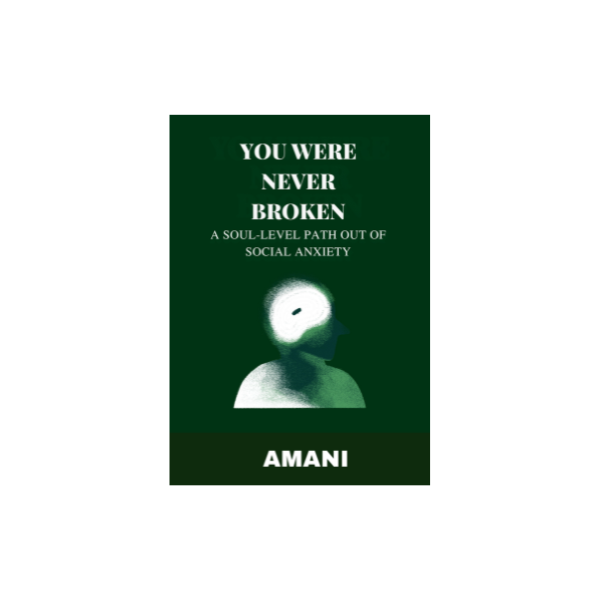
I know how that sounds. I know it sounds like urgency designed to make you buy something. I want to say it anyway, because it is true, and because I wish someone had said it to me when I was in my early twenties quietly deciding to wait.
The change, when it finally came for me, did not arrive in a thunderbolt. It arrived in the quiet accumulation of mornings. Every week felt a little less heavy than the week before. Every month, the spiral at 2 a.m. got a little quieter. Every few months, I noticed that I had walked into a room without rehearsing, or made a phone call without drafting the script, or said a thing I actually meant without spending two days wondering if I should have said it differently.
But I started that work late. I lost years to the quiet resignation of someone who had convinced themselves that this was just who they were. The parked car was still parked. The text was still half-typed. The aisle was still waiting to empty.
I cannot get those years back. I am not writing this from regret — I am writing it from love, to you, the person who is reading this and thinking: maybe next year, maybe when things settle down, maybe when I feel more ready.
You will not feel more ready. Ready is not a feeling that arrives before the work. Ready is a feeling that shows up, slowly, because of the work.
The question is not whether you are ready. The question is whether you are willing.
One-time investment. No subscription. Yours forever.
Instant digital download. Read on any device.
Yes — I Want the BookSecure checkout. Immediate access.
You don't have to buy anything to go look at it. You don't have to sign up for anything. If anything in this piece landed for you — the café, the parked car, the 2 a.m. clip — read on and see if this is the thing that finally moves for you after everything else has stayed still.
If you do nothing else after reading this —
take one sentence with you.
"You were never broken. You were a person who got handed a story that was too heavy to carry, and nobody ever showed you how to put it down, and you have been carrying it anyway, all by yourself, for years — and the carrying is not evidence that you were broken. The carrying is evidence that you were strong."
The café is still waiting for you. The parked car is still waiting for you. The party you drove to and left without going in is going to happen again, and soon, and I know it.
But the version of you who can walk into that café without flinching is already in there. Already ordering. Already smiling at the cashier. Already by the window with the cup in their hands and the light on their face and the spiral nowhere in the room.
That person is not a fantasy. That person is who you actually are, underneath everything that got installed on top.
They have been waiting for you
for a long time.